
Why Generic Web Design Platforms Fail Academic Websites
Generic website builders cannot meet the complex, highly customized needs of academic and research websites. Learn why universities and labs need specialized web design.
11/27/20252 min read
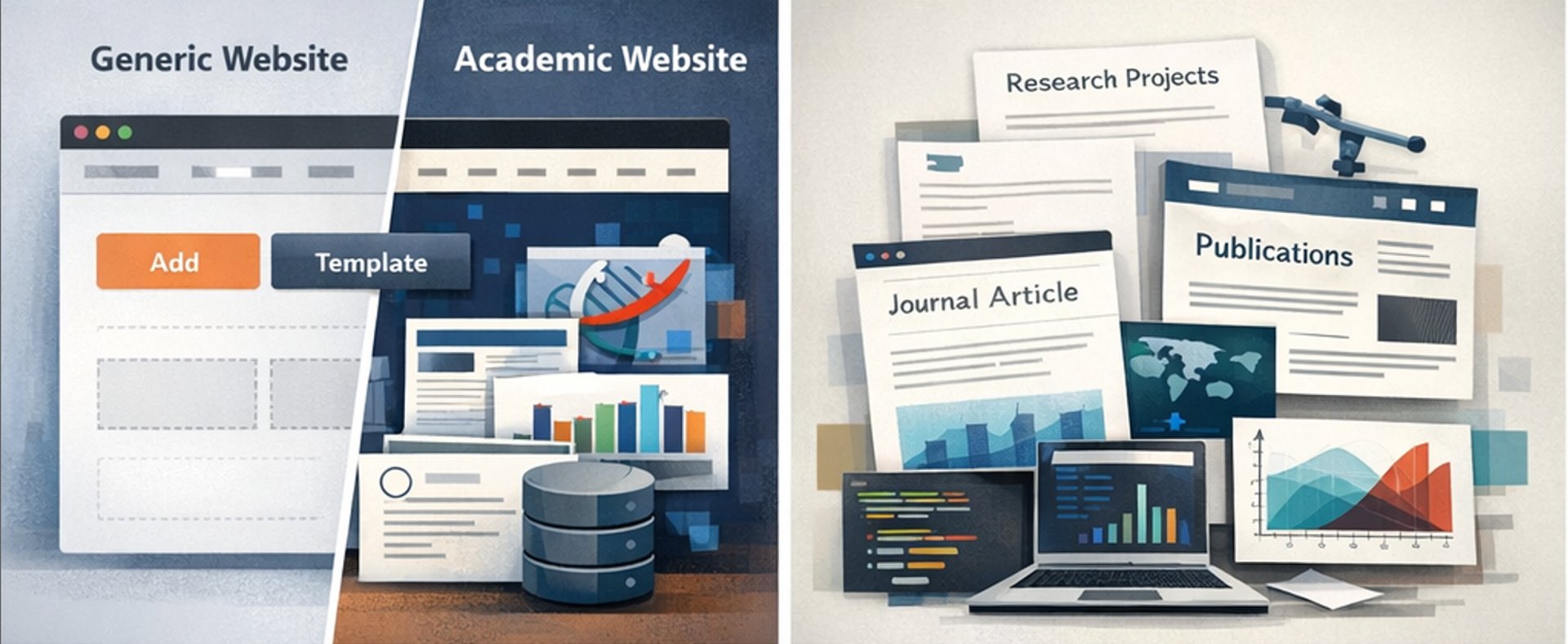
Academic Websites Are Not “Just Another Website”
Generic website builders are designed for scale. They work well for small businesses, personal portfolios, and marketing pages.
Academic websites, however, operate under a very different set of expectations. Research groups, laboratories, and universities require websites that are precise, structured, and highly customized — not only visually, but conceptually.
This fundamental mismatch is why generic web design platforms consistently fail to meet academic needs.
1. Research Content Is Structurally Complex
Most website platforms assume content falls into simple categories:
Pages
Blog posts
Products
Academic content does not.
Research websites must handle:
Multi-year projects
Publications across journals and conferences
Datasets, software, and protocols
Cross-institution collaborations
Generic platforms flatten this complexity into static pages, making it difficult to reflect the real structure of research work. You could check our real examples on projects page (https://researchbuilder.online/projects).
2. Academic Websites Require Extreme Customization
Each lab has:
A unique research focus
Different funding structures
Specific institutional requirements
Distinct collaboration models
Generic platforms prioritize uniformity for efficiency.
Academic websites require tailored solutions to accurately represent the research.
What works for a business landing page rarely works for a research group.
3. One-Size-Fits-All Design Undermines Academic Credibility
In academia, visual tone matters.
Overly commercial layouts, aggressive calls-to-action, or trendy animations can:
Reduce perceived rigor
Conflict with institutional branding
Create friction with review committees or funding agencies
Generic platforms are optimized for conversion.
Academic websites must prioritize clarity, restraint, and credibility.
4. Maintenance Becomes a Long-Term Problem
Research websites are not static.
They evolve as:
Team members join and leave
Projects progress or conclude
Publications accumulate
Grants and collaborations change
Many generic platforms lock users into rigid structures or proprietary systems, making long-term updates increasingly difficult.
Why Specialized Research Web Agencies Matter
A research-focused web agency does not start with templates.
It starts with understanding the research itself.
This includes:
Mapping research structure before design
Designing around projects and outputs, not marketing goals
Respecting institutional tone and academic norms
Building systems that scale with research growth
This approach acknowledges a simple reality:
Academic websites fail not because researchers lack tools, but because generic platforms are not built for research.
Final thoughts
Generic web design platforms are efficient by design.
Academic research is not.
Universities and research groups require websites that reflect the complexity, individuality, and rigor of their work.
Meeting those requirements demands more than a drag-and-drop builder —
it requires specialized understanding and deliberate design.
If your research group or institution is planning to redesign its website, working with a team that understands academic requirements can prevent long-term structural problems. You can reach us via our contact page (https://researchbuilder.online/contact) to discuss your research website needs.


Stay in touch about research websites
© 2025 ResearchBuilder. All rights reserved.


Building research websites and data platforms for universities, labs, and research groups.